


As of the Patch 1.07 evidence cutoff, no controlled retail benchmark or complete capture of GRAIN ROT’s current graphics menu supports one universal preset. The safest GRAIN ROT best settings baseline starts from the current defaults: record them, change one verified option at a time, and compare the same Outpost-to-ruins route. Diagnose steady low FPS, physics or combat drops, loading hitches, online delay, and save or client bugs separately. Patch 1.01 repaired one light-invalidation defect that had made performance worse than expected, but its notes provide no universal performance gain.
BEFORE THE NEXT DESCENT
Clear PC-side clutter first
Let Hone reduce avoidable Windows background load, then test one GRAIN ROT setting at a time.
Optimize with HoneWhat Patch 1.07 actually changes
Patch 1.07, published August 12, 2026, is the latest verified update at this guide’s cutoff. It added a public-server browser, host game settings under the multiplayer options tab, password protection, expanded friend and invite privacy, and a hat in the Deep Layers. These are session-management changes. The notes claim no graphics uplift, frame-pacing improvement, or netcode change.
Earlier, Patch 1.01 fixed a light-invalidation bug that had made performance worse than expected. That is one historical repair—not a general FPS boost or stutter cure. Other launch patches addressed joining, client doors, save loading, item ownership, respawning, and stacked-object behavior. Treat those as state or multiplayer fixes, not FPS results. The official What’s Next announcement says fixes, performance improvements, balancing, and quality-of-life work will continue. Those are plans, not completed changes.
Safe current-build starting point
No current first-party or reproducible retail capture establishes exact graphics labels, values, defaults, ranges, hardware constraints, or restart requirements. Secondary traces suggest broad Game, Audio, and Video categories; the verified multiplayer options tab is not a graphics menu. This guide therefore cannot supply recommended values for resolution, presets, textures, shadows, effects, anti-aliasing, view distance, brightness, or V-Sync.
Record every current value. Preserve the defaults, then test only an option actually present, changing one variable before repeating the route. Photograph the menu first, note whether a restart is requested, and reject any run whose route, role, or player count changes. Compare dark-scene visibility side by side; hiding enemies, routes, or interactable objects is not a clean win. Then choose a realistic FPS target that the slowest repeatable scene can sustain instead of chasing an idle peak.
FPS counts displayed frames per second. Frame time measures frame duration, exposing spikes an average can hide. A 1% low summarizes the slowest portion, but its method must remain consistent. Presented cadence tracks game submissions; displayed cadence tracks visible updates. VRAM is graphics memory, not system RAM.
MARK → HAUL → BURN → RETURN
Compare the haul
| Run | Average FPS | 1% low FPS |
|---|---|---|
| Before | ________ | ________ |
| After | ________ | ________ |
Change = After − Before. Report both signed differences, then repeat the route before keeping a change. If either falls, inspect and consider reverting.
Match the fix to the workload
Solo establishes local rendering and simulation. Host adds simulation and replication—keeping session state synchronized—but a host delta does not prove a CPU limit. Client adds network behavior. Test one PC in each role where practical. Match save, Outpost complexity, route, party size, loadout, carried state, and settings. Keep operating-system and driver state fixed.
- Outpost: match camera, save, furniture count, and one Grinder action. Label sparse and developed states.
- Descent/loading: measure elevator input through control return; separate transitions from active-play FPS.
- Physics/destruction: break the same object class and count at a fixed cadence; test fire separately.
- Combat: match party, loadout, and actions; separate pre-wave, peak pressure, and cleanup.
- Extraction/loading: match carried load and state; separate transition, Outpost recovery, and active play.
- High-chaos co-op: compare a timed carry, dropkick, trap, destruction, and combat script with calm co-op. Combined load proves no single cause.
Because ruins shift procedurally, match event-relative scripts, durations, object counts, party state, and invalidation rules. Reject mismatched runs. A GPU limit needs GPU time and a controlled setting response. CPU or simulation pressure needs weak resolution scaling, leading CPU time, and symptoms that grow with enemies, destruction, Outpost complexity, or hosting. VRAM pressure needs matching telemetry; no universal cutoff exists.
Do not call everything “lag.” Use fix FPS drops for cadence loss. Rubber-banding or delayed interactions may be network behavior while cadence stays stable; compare round-trip time (RTT), jitter, loss, and host state. Loading stalls belong to transitions. Persistence, ownership, key binds, visibility, and interaction failures are save, state, or client defects—not rendering FPS.
Cap, sync, and advanced-feature boundaries
No current in-game limiter or V-Sync implementation is verified. Run uncapped first to expose the slowest route. If your menu confirms a limiter, test it first; otherwise a driver or RivaTuner Statistics Server (RTSS) limiter is a conditional fallback. Use one active limiter at a time, then choose a cap the slowest route can hold with headroom. There is no universal value.
On a verified variable refresh rate (VRR) display, VRR plus the platform V-Sync path and a below-ceiling cap is a starting test. The NVIDIA pattern—G-Sync, driver V-Sync On, in-game V-Sync Off—is system guidance, not a verified GRAIN ROT menu fact. V-Sync Off may tear; V-Sync can add latency.
DLSS, FSR, XeSS, dynamic resolution, Frame Generation, ray tracing, Reflex, NVIDIA Low Latency, and AMD Anti-Lag are unverified. Do not claim support or recommend a mode. If upscaling appears, hold base and output resolution constant while comparing clarity and cadence. If Frame Generation appears, separate base from generated FPS and disclose latency and artifacts; it cannot hide an unplayable base rate.
Can your PC run GRAIN ROT?
The official Steam listing gives these Windows requirements. On a narrow screen, use the table’s local horizontal scroll rather than zooming the whole page.
Swipe to compare minimum and recommended hardware →
| Part | Minimum | Recommended |
|---|---|---|
| OS | Windows 10 64Bit | Windows 10 64Bit |
| Processor | Inter Core i5-4590 / AMD Ryzen 5 2600 | Intel Core i5-10600 / AMD Ryzen 5 3600 |
| Memory | 8 GB RAM | 8 GB RAM |
| Graphics | NVIDIA GTX 970 / AMD Radeon R9 390 | NVIDIA RTX 2060 / AMD Radeon RX 5700 |
| DirectX | Version 11 | Version 11 |
| Network | Broadband Internet connection | Broadband Internet connection |
| Storage | 10 GB available space | 10 GB available space |
“Inter” is Steam’s apparent typo, preserved because the table quotes the listing. Neither tier specifies resolution, preset, FPS target, frame-time target, VRAM, role, or route. Treat it as an eligibility reference, not a promise of smooth play. Steam lists Windows support; macOS and Linux are not listed. Full controller support does not verify Steam Deck compatibility. Without repeatable current-device testing, this guide cannot guarantee Deck behavior, FPS, image quality, battery life, or a universal recommendation.
Run the same test route
No official benchmark is documented, and this article contains no controlled retail result. Record build, OS, driver, hardware, resolution, refresh rate, VRR range, verified options, limiter source and value, V-Sync location, role, party size, save, and Outpost state.
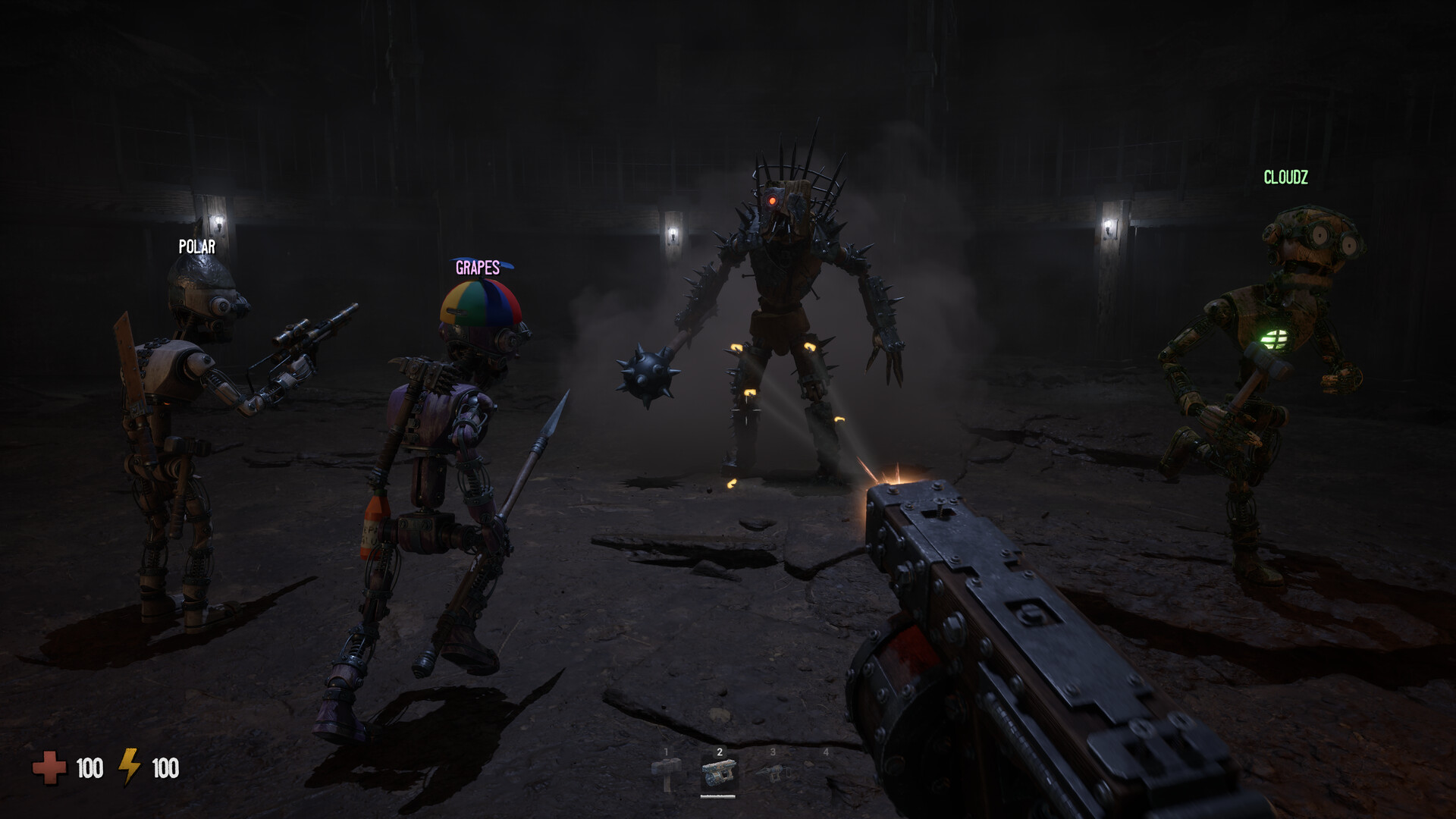
THE FOUR-STAGE DESCENT
Burn the same route
- Outpost idle — Hold the same view. Record resolution, verified settings, cap or sync state, average FPS, 1% low or frame-time behavior, CPU/GPU frame time, and VRAM where available.
- Ruins traversal — Follow the same event-relative path and duration. Match player count, host, lighting, and camera movement.
- Corrupted pressure — Repeat the same combat or effects-heavy event with matched players and loadout. Separate frame-time spikes from network delay.
- Return and compare — Complete or exit, enter both results, and repeat. Keep a change only if the diagnosed limit improves without visual loss or instability.
Capture three valid warm repetitions; first-run claims need three independent cold launches. Compare one variable at a time by alternating before and after runs or randomizing order, with invalidation rules. Keep frame-time plots, defined lows, CPU/GPU frame times, memory, storage I/O, and relevant network telemetry. Save screenshots and raw telemetry logs before drawing any final conclusion. Never mix loading stalls with combat averages or infer click-to-photon latency from FPS.
Reversible troubleshooting
Start with reversible steps. Restore defaults and reproduce the symptom. Verify Steam files, then update to a supported GPU driver and Windows release. Close nonessential applications and overlays one at a time; PC stuttering in games may have causes separate from online delay. Preserve saves before troubleshooting state or loading problems.
Note where failure occurs: startup, menu, descent, combat, extraction, hosting, joining, or client interaction. Log build, save, role, party, route, settings, driver, and warm state. For an anecdotal “1 FPS” symptom, compare gameplay and cutscene telemetry, then separate rendering, loading, and host or client behavior. If the issue appears only online, repeat as solo, host, and client before changing graphics. Preserve the same save and party size throughout.
You can optimize your PC for gaming by reducing avoidable background load, but keep changes controlled. Avoid real-time priority, registry “FPS packs,” random configurations, undocumented launch flags, blanket BIOS changes, and routine cache deletion. They add risk and obscure the fault.
Final advice
The safest GRAIN ROT best-settings plan is a disciplined loop: mark the defaults, isolate the symptom and role, change one verified option, burn through the same route, and return to the ledger. Favor stable displayed cadence and readable dark scenes over a flattering idle average, and revert any change that adds instability or hides useful detail.
AFTER THE BURN RUN
Repeat the descent on a cleaner PC
Use Hone for cautious system optimization, then rerun the same GRAIN ROT route and compare the ledger.
Get Hone FreeGRAIN ROT performance FAQ
What are the best GRAIN ROT settings for FPS?
No controlled current-build profile is verified. Start from current defaults, record every visible value, change one verified option at a time, and repeat the same route. Compare displayed frame times and consistently calculated 1% lows—not only average FPS—while preserving dark-scene visibility.
Why is GRAIN ROT stuck at 1 FPS during gameplay?
Treat 1 FPS as an anecdotal severe symptom, not a common known cause. Compare gameplay and cutscene telemetry, restore defaults, verify Steam files, and note whether it begins during loading, rendering, hosting, or client play. Avoid unsupported BIOS changes, registry edits, and downloaded configurations.
What are the GRAIN ROT system requirements?
Steam lists Windows 10 64Bit, 8 GB RAM, DirectX 11, broadband, and 10 GB storage for both tiers. Minimum graphics are GTX 970 or Radeon R9 390; recommended graphics are RTX 2060 or Radeon RX 5700. No tier specifies resolution, preset, target FPS, frame-time result, or host or client outcome.
Can GRAIN ROT run on Steam Deck?
Steam lists Windows support, not Linux. Full controller support confirms input support, not Steam Deck compatibility. Without current-build device testing, do not assume FPS, battery life, compatibility, image quality, or a universal recommendation.
How do I fix GRAIN ROT crashes or startup problems?
Identify whether failure occurs at startup, in the menu, while loading, or in-session. Restore defaults, verify Steam files, update supported drivers and Windows, and disable nonessential overlays or background tools one at a time. Preserve saves and record the build and context. These safe checks cannot promise a fix.




 Youtube